De-risking medtech innovation - balancing technical achievements and commercial viability
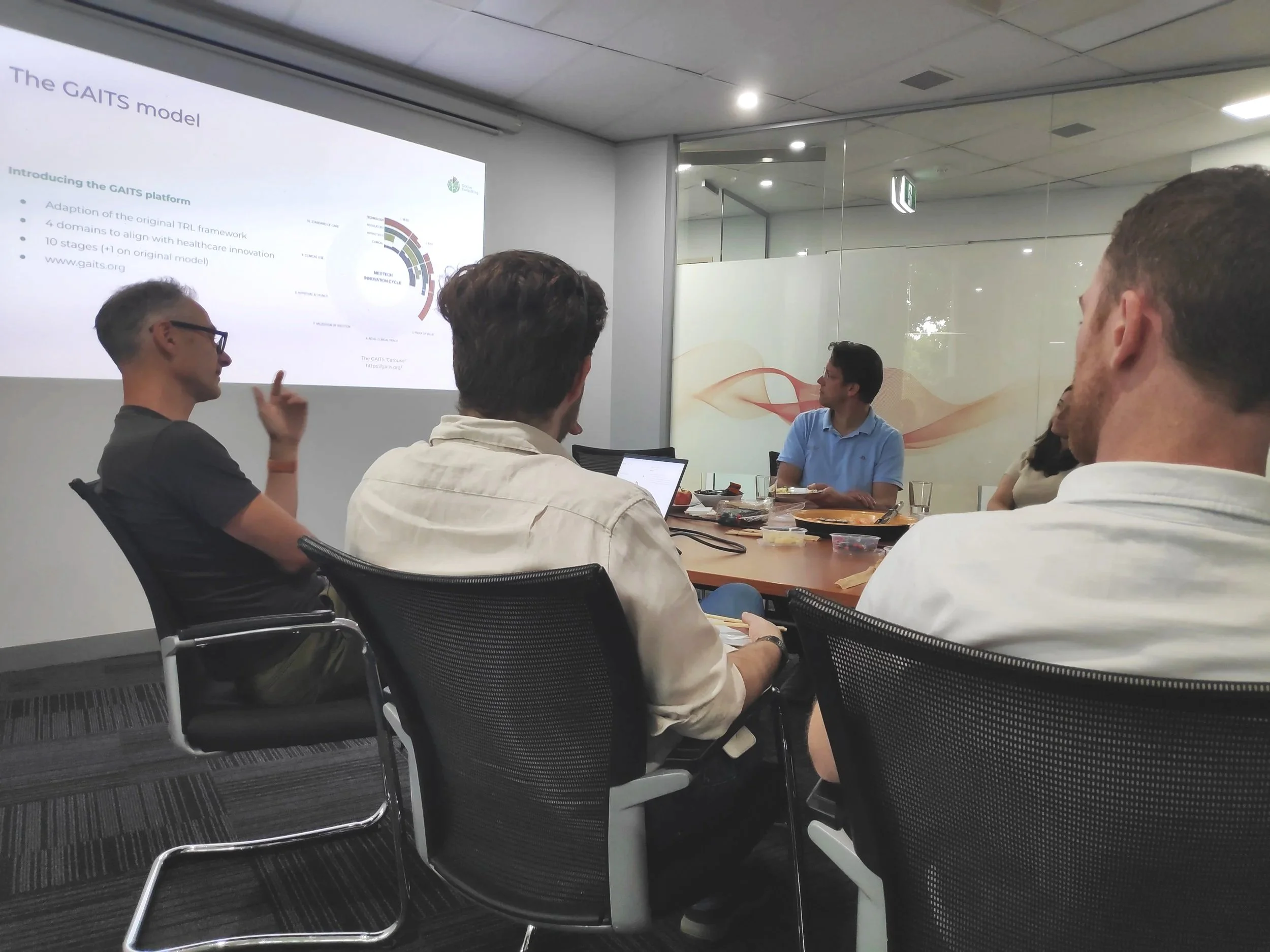
In the recent FB IDEAs lunch & learn session Tom Harris of Octive Consulting shared how to overcome the challenges of taking medical technologies from early development to scalable production using a structured approach.
Preparing for investment readiness
Opening the session with a reality many innovators in medtech face, Tom Harris brought it to the point: There is a changing funding landscape along the technology readiness pathway which makes funding relatively accessible, eg. through grants, at early stages such as TRL3. However, funding often becomes significantly harder to secure between TRL4 and TRL6. This is just when companies must invest heavily in development, testing and regulatory preparation. Closing the gap at this stage can be supported by using the Guidance and Impact Tracking System (GAITS). GAITS is freely available and helps to look closely at technology, regulatory, market/business and clinical aspects in a structured approach.
This is the system Tom Harris uses when he supports medtech innovators on their pathway from innovation to commercialisation to poof their investment readiness. In this session, he shared his experience with the participants. One piece of advice that strongly resonated with the audience was not to underestimate the importance of documentation from the very beginning. Recording requirements and maintaining a detailed and complete design record are essential to support verification and validation later on. These elements fundamental to regulatory approval cannot be reconstructed retrospectively. Tom also guided the audience through critical pressure points in manufacturing development, including process validation, operational and performance qualification, and the transition from pilot to production.
Avoiding cash traps and protecting IP
Supply chain assurance emerged as another major risk factor for early-stage medtech companies. With multifarious interfaces of suppliers and components, the system can become complex quickly, but needs to be in the focus early as investors recognise it as an asset. If supply is not balanced with demand, overstocking can tie up significant amounts of capital. Australian-specific supply chain considerations sparked particular interest in the room.
The discussion also explored the advantages and trade-offs between keeping production in-house versus using contract manufacturing. Protecting intellectual property remains a genuine concern, not only for founders but also from an investor perspective. As companies plan for scale, establishing a clear strategy for quality control, oversight, communication and cultural alignment with manufacturing partners becomes essential.
Contrasting commercialisation skills and international funding markets
Another topic discussed was where Australian medtech ventures often struggle. Tom described a divide between highly advanced technologies emerging from research environments or accelerators where commercial understanding is not the key strength, and commercially experienced operators with market knowledge and established systems in place but lacking the underlying technology. While this appears to present natural opportunities for collaboration, only a relatively small proportion of biotech research and patents ultimately reach commercialisation.
The conversation broadened to compare international funding environments and differing attitudes toward risk. We heard that demonstrating a track record in capital utilisation and delivering against milestones can significantly improve investor confidence and funding prospects, as do well-balanced teams. Finally, the importance of reimbursement pathways, specific to medtech, was highlighted. Even highly innovative products face major barriers when the question who pays is not answered through established reimbursement codes that integrate in healthcare systems.
Tying this all together, Tom Harris drew a picture of a structured approach to guide innovators from early stages to commercialisation and help them prove their investment readiness.
Get Involved in the Hub
We have a regular program of events and networking opportunities at the FB IDEAs Hub, and throughout Fishermans Bend. Subscribe to our monthly eNews to get updates!
You might also like to join the FB IDEAs Hub community. Located within walking distance of the future Fishermans Bend Innovation Precinct, the Hub is more than just a co-working space — it’s a community where the future is being actively built.
We offer free* co-working space (* subject to T&Cs) and the chance to be part of a growing start-up ecosystem working across cleantech, aerospace, renewables, regenerative architecture, placemaking, product design, circular economy, business consulting and much more.
Applications now open!
